Wednesday, October 23, 2013

Much Ado About Nothing (2012)

**

An excerpt of a review recently posted on Schaeffer's Ghost:
In the ‘Making Of’ featurette, Whedon explains that he sees Much Ado as, essentially, a dark noir story, which makes the black-and-white film choice all the more appropriate. However, with all due respect to Mr. Whedon (and I do respect him deeply and have greatly enjoyed his previous productions), I think he’s dead wrong. Much Ado is, at its heart, a lighthearted romp. It is a classic comedy, full of humor and good cheer from start to finish: from Beatrice and Benedick’s zippy one-liners, to the farcical plot by their friends to entangle them romantically, to Dogberry’s mind-boggling incompetence, it is just fun. The worst thing that happens is a couple of misunderstandings, each of which is cleared up in a matter of hours. Yes, those misunderstandings lead to some heart-wrenching scenes, and very nearly have fatal consequences for those involved, but in the end it all works out. The villain runs off and is apprehended off-screen, and everyone lives happily ever after. Everyone is essentially good and likable except the malevolent (and ultimately ineffective) Don John and his henchmen. That’s … not really noir. At all.
Full review available here.

Monday, October 21, 2013

Death by Living: Life Is Meant to Be Spent, by N.D. Wilson

**

An excerpt of a review recently posted on Schaeffer's Ghost:
[...] Wilson’s style reminds me of nothing so much as one of those trailers from uber-hipster Rob Bell. You know the ones—full of sentences and fragments and ideas woven together to establish his point (or the question he wants to ask). If I’m being honest, part of my discomfort with the book is probably the result of this marked similarity to such a well-known and deeply troubling author. Fortunately, the similarities between Wilson and Bell begin and end at the stylistic level. As far as I can tell from this work, Wilson definitely has it on Bell in the theology department: what theology there is here seems fine. But I find Bell’s writing disturbing, and it’s difficult to read such a similar style without a certain amount of reflexive discomfort. (Then again, I will say this for Bell: I always know what his take-away point is. As unorthodox and problematic as his conclusions may be, Bell never leaves you wondering what those conclusions are.)
Full review available here.

Monday, October 14, 2013

What Are You Afraid Of? Facing Down Your Fears with Faith, by Dr. David Jeremiah

****

An excerpt of a review recently posted on Schaeffer's Ghost:
I confess, I know next to nothing about Dr. David Jeremiah. I’ve heard the name, sure, and am vaguely aware of a radio program and possibly a televised sermon. But, well, televangelism and religious radio programming being what they are, I was more than a little skeptical when I first cracked open his latest work, What Are You Afraid Of? Imagine my delight when I discovered that Dr. Jeremiah’s analysis of fear is both biblically sound and practically helpful. In fact, I was originally asked to read and respond to a single chapter, but I was so pleasantly surprised (and impressed) by the substance of the book that I went ahead and read the whole thing.
Full review available here.

Monday, October 7, 2013

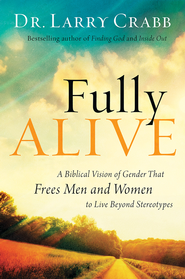
Fully Alive: A Biblical Vision of Gender that Frees Men and Women to Live Beyond Stereotypes, by Dr. Larry Crabb

**

An excerpt of a review recently posted on Schaeffer's Ghost:
The trouble is the foundation of Crabb’s framework. Although the book purports to be based on a biblical understanding of femininity and masculinity, the primary basis for Crabb’s ideas seems to be … the sex act. Or at least the human reproductive system. Like John Eldredge before him, Crabb sees in sexual intercourse a physical picture of biblical gender roles. Actually, no. That’s not accurate. That might be ok. Crabb seems to see gender roles as a picture of sex. In other words, rather than starting with a study of Scripture as a whole in an attempt to discern its teaching on gender, he seems to start with sex and then cherry-pick the bible verses that best support his claims. 
The entirety of his argument regarding ‘biblical’ femininity seems to rest on the fact that the Hebrew word for ‘female’ is etymologically connected to the word for ‘perforated or punctured’—that is, something with holes in it. Even assuming that he’s done his homework here, and that the etymological connection is a reference to the female sex organ—that somewhere back along the line, the Hebrew term for female was essentially ‘something you nail’—those etymological connections are not an adequate basis for an entire philosophy of gender.
Full review available here.

Wednesday, October 2, 2013

Dealing with Dragons, by Patricia C. Wrede

****

An excerpt of a review recently posted on Children's Books and Reviews:
Cimorene is a princess who would make any feminist proud. If The Paper Bag Princess managed to avoid the temptation to bitterness and misandry, she might well have grown up to be Cimorene. Dissatisfied with her feminine lot, she persuades her father’s various retainers to teach her fencing, cooking, magic, and Latin. [...] Rather than simply complaining about the injustice of her circumstances, she rolls up her sleeves and changes them. [...] Where her sisters simper stupidly and whine when they don’t get their way, Cimorene is intelligent, innovative, hardworking, and possessed of more than her fair share of common sense. [...]
As role models go, young female readers could do a lot worse than Cimorene.
Full review available here.

Monday, September 30, 2013

Every Body Matters: Strengthening Your Body to Strengthen Your Soul, by Gary Thomas

****

An excerpt from a review recently posted on Schaeffer's Ghost:
[...] We know from Scripture that Christians’ bodies are ‘the temple of the Holy Spirit.’ We are not our own; we were bought with a price. It follows, therefore, that we are to honor God with our bodies. After all, everything we have—including our bodies—was entrusted to us by God for the purpose of glorifying Him and enjoying Him forever. It is our chief end. But all too often we act like our purpose is to dishonor Him (or glorify ourselves), and enjoy bacon forever. Our gods are our stomachs, and we alternate between expanding them by our indulgences and making an effort to undo those indulgences and shrink them down again. We enjoy our Doritos (or our flat abs) more than we enjoy our sovereign creator who loves us and redeemed us. Like the servant entrusted with one talent, we are crummy stewards, and thereby tell the world that the Master we claim to serve really isn’t worth respecting. [...]
Full review available here

Wednesday, September 25, 2013

Crazy Busy: A (Mercifully) Short Book About a (Really) Big Problem, by Kevin DeYoung

****

These days, it seems that 'Busy' has replaced 'Fine' as the stock answer to casual 'How are you?' inquiries. Everyone we know is busy busy busy, and we ourselves are no exception. But how should we as Christians think about our hectic and sometimes over-scheduled lives? Is our frantic pace a good thing--an indicator of our dedication to Kingdom Matters? Or is it a bad thing--a failure to 'Be still and know that I am God'? What of the spiritual reality behind our perpetual busyness? What's really going on when we're so all-fired busy all the time?

Pastor and author Kevin DeYoung takes on these questions, and many more, in his new book Crazy Busy. As the longish subtitle indicates, the book is no tome: it clocks in at around 120 pages in paperback format, or right around 3 hours if you opt for the audiobook version, as I did. In other words, you should have time to read (or listen to) this book, even if it's only in short increments while running errands, exercising, or while on the throne. DeYoung writes concisely and clearly, and the audiobook narration makes it easy to listen to and absorb. (DeYoung's voice is not quite as universally familiar as, say, John Piper or Mark Driscoll or even David Platt or Matt Chandler, so the shock of hearing his words read by someone else is much less jarring here.) However, as with any audiobook, retention can be a problem--you can't just underline particularly convicting or helpful passages (of which there are many) for future reference.